
Introduction
Pull up your practice website right now. Click on Services. Scroll down. Find Implants. Now keep scrolling — past the cleanings, the fillings, the Invisalign, the whitening, the crowns. There it is. A paragraph. Maybe two. A stock photo of a smiling model with suspiciously perfect teeth. A “Book an Appointment” button.
That is the page you are asking a patient to trust with a $50,000 decision.
Your All-on-X dental implants marketing does not begin with the ad. It begins with the website the ad sends people to. The site may be ranking. It may not be converting. Those are two entirely different problems, and most practices only solve one of them.
General practice websites are engineered for the easiest decisions patients make — scheduling a cleaning, asking about whitening, looking up office hours. Full-arch implants are the opposite of an easy decision. They are high-investment, high- emotion, high-trust decisions made by people who have been researching for months, comparing practices, and asking themselves a version of the same question:
“Is this the right place to trust with my face?”
This article explains exactly what needs to change on your website — and why — to convert more full-arch cases. The self-audit checklist is in Section 10 if you want to assess your current site before reading further.
Most general practice websites lose All-on-X cases not because of poor traffic, but because the site fails to communicate specialization, authority, and a guided patient journey. The dental industry’s average website conversion rate is 2.3%, while top performers reach 23.1% (Ruler Analytics). The gap is structural and trust-based — not a traffic problem.
Why Do Most General Practice Websites Repel Full-Arch Patients?
The dental industry’s average website conversion rate is 2.3%. Top-performing practices reach 23.1% (Ruler Analytics). That ten-fold gap is not explained by traffic volume or ad spend. It is explained by trust architecture — how well the website signals that this practice is the right choice for this specific treatment.
Dental industry average conversion rate
Top performers (Ruler Analytics)
For most general practice websites, full-arch implants are positioned as one service among thirty. They appear in the same navigation menu as composite fillings and teeth cleanings. They are described in the same generic language, styled with the same stock imagery, and given the same two-paragraph treatment as every other procedure on the page.
A patient spending $40,000—$60,000 on a full-arch restoration is not evaluating convenience or availability. They are evaluating expertise, trust, and certainty. When your website treats All-on-X as one item in a long services list, it signals exactly the opposite of what that patient needs to see.
This is not a traffic problem. It is a positioning and trust problem.
High-ticket cases require high-trust websites.
The “One More Service” Trap
Here is the part most practices miss. Implant patients do not behave like routine dental patients. A routine patient needs a dentist who is nearby, takes their insurance, and has availability. An implant patient needs a provider they believe is genuinely expert in this specific procedure — someone who performs full-arch restorations regularly and has the outcomes to prove it.
When All-on-X appears beside teeth whitening and Invisalign in your services menu, the implicit message is that your practice does all of these things with equal frequency and commitment. That message undermines the perception of specialization that full-arch patients require before they will pick up the phone.
Remove full-arch implants from the general services menu. Create a dedicated navigation pathway — “Implant Center” — that signals the practice treats this as a distinct, prioritized service line rather than an incidental offering.
What Is the Mindset Difference Between Hygiene Patients and Implant Patients?
A hygiene patient searches for “dentist near me,” checks that you accept their insurance, confirms you have a Tuesday morning slot, and books. The entire decision happens in minutes. The risk of being wrong is minimal — a bad cleaning is annoying, not life-altering.
An All-on-X patient does none of this.
Before they contact your practice, most have spent weeks or months researching the procedure, reading patient stories, watching videos, comparing providers, and working through the financial reality of a $40,000—$60,000 out-of-pocket investment. Patients visit an average of 2—3 provider websites and read approximately 5 reviews before making a healthcare provider decision (Press Ganey, 2023).
For a full-arch case, those numbers are conservative. This patient is not casually browsing. They are in evaluation mode.
The patient inner voice during that research period sounds like this:
- “What if I pick the wrong dentist?”
- “What if I spend this money and it does not work?”
- “I cannot afford another mistake.”
- “Why should I choose this practice over the one down the street?”
Your website must answer those questions before the patient ever calls. It cannot do that if it is designed for the patient who already knows they want to book.
If your website only converts the patient who is already sold, it is doing a fraction of the work it should.
Why the Same Website Cannot Serve Both Patient Types Equally
This is the structural tension inside every general practice website. Routine patients need fast navigation to appointment booking. Full-arch patients need a guided journey that builds trust over multiple pages and multiple visits before conversion.
The solution is not to choose one patient type over the other. It is to build two distinct pathways within the same site — a general dentistry lane for routine patients, and a dedicated implant center lane for full-arch prospects. The practice benefits from both. But only one of those pathways requires intentional, specialized architecture to function.
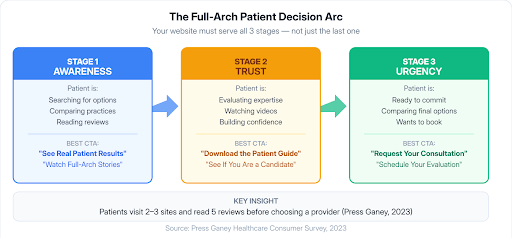
The All-on-X patient follows a three-stage arc: Awareness → Trust → Urgency. Your website must serve all three stages, not just the last one. A “Book Now” button only serves the patient in the Urgency stage. The patient in the Awareness and Trust stages needs education, proof, and a guided next step that does not demand premature commitment.
How Do You Reposition a General Practice Homepage for All-on-X Expertise?
The homepage is where most full-arch patients form their first impression of your practice. What they see in the first three seconds — before a single scroll — determines whether they continue or leave. For a general practice that wants to grow its All-on-X case volume, the homepage must make two things immediately legible: that the practice offers full-arch implants, and that it treats them as a priority, not a side service.
Above-the-Fold Copy Strategy
The above-fold content — everything visible before scrolling — must include at minimum: a headline that references the transformation or the patient’s problem, a supporting subheadline that introduces the All-on- X solution, and a call to action that invites exploration rather than demanding commitment.
“Welcome to [Practice Name], serving [City] for over 20 years.”
“Permanent Teeth in One Visit. Full-Arch Implants for Patients Who Are Done with Dentures.”
The second version speaks to the patient’s pain point (living with dentures), names the outcome they want (permanent teeth), and signals a specific clinical capability (one-visit protocol). It is not more clever — it is more specific.
CTA above the fold: Avoid “Book Now” at this position. The patient is in awareness mode.
A low-friction CTA like “See Real Patient Results,” “Watch Full-Arch Stories,” or “Explore Our Implant Center” invites them to learn more without demanding a commitment they are not ready to make.
How to Signal Specialization Without Losing General Dentistry Patients
Adding “Implant Center” as a top-level navigation item is the highest-leverage homepage change a general practice can make for full-arch case volume. It does two things simultaneously: it creates a dedicated pathway for implant prospects, and it elevates the perceived quality of the entire practice for every visitor.
A practice whose navigation reads like:
… reads as more specialized than one whose navigation reads:
… even if both practices perform the same procedures at the same volume.
Navigation architecture signals intent. “Implant Center” implies volume, process, and commitment.
“Services → Implants” implies the practice also happens to do this.
Importantly, this change does not repel routine patients. Routine patients will navigate to “Services” regardless. What changes is the experience of the full-arch prospect, who now has an obvious, dedicated path to the information they need.
Generic Dental Website vs. Full-Arch Conversion Website
Navigation
Services → Implants (buried)
Implant Center (top-level nav)
Homepage
General welcome, all services equal
Full-arch featured above fold
Imagery
Stock photos
Real patient before-and-after
CTAs
“Book an Appointment”
Awareness → Education → Action sequence
Landing page
Short service paragraph
Dedicated page: candidacy, process, proof, CTA
Proof
Generic testimonials
Named full-arch patient outcomes + video
Conversion rate
Industry avg: 2.3%
Top performers: 23.1%
What Should an All-on-X Dental Implant Landing Page Actually Include?
A patient who has spent three months researching full-arch implants arrives at your service page expecting depth.
They want to understand whether they are a candidate.
They want to understand the process.
They want to see what outcomes look like.
They want to know who the doctor is and why they can be trusted.
A two-paragraph service blurb answers none of those questions.
If your All-on-X page is fewer than 800 words, it is not a landing page. It is a paragraph with a form — and it is quietly losing you cases every week.
A dedicated All-on-X landing page should include nine components:
Above-the-fold hero
headline, subheadline, outcome-oriented CTA
Candidacy section
who this treatment is for (edentulous patients, failing dentition, denture wearers, bone loss candidates)
Process overview
what happens from initial consultation to final arch delivery, in plain language
Doctor authority section
credentials presented in context, not just listed
Before-and-after gallery
full-arch cases specifically, with patient story captions
Patient video testimonials
real patients describing their experience and outcome
Investment and financing section
monthly payment framing alongside total investment range
FAQ block
6—12 questions targeting the consideration-phase patient
Final CTA
consultation request or candidacy evaluation, with trust signals adjacent
Above-the-Fold Copy Strategy for the Landing Page
The landing page headline serves a different purpose than the homepage headline. On the homepage, you are signaling that you specialize. On the landing page, you are addressing the patient’s specific concern and inviting them to take the next step.
The most effective CTA for the All-on-X landing page is not “Book Now.” It is “See If You Are a Candidate” or “Request Your Implant Consultation.”
Demands a commitment from a patient who is still in evaluation mode.
Meets the patient where they actually are: uncertain, researching, and looking for guidance.
It removes the pressure of committing to an appointment and replaces it with an invitation to learn whether this is even the right path for them.
That reframing reduces friction at the most important decision point on the page. It also pre-qualifies intent; a patient who clicks “See If You Are a Candidate” is signaling genuine interest, not casual curiosity.
Clarify Your Positioning — Who You Help and What Problem You Solve
Most All-on-X copy on general practice websites describes the procedure. It mentions titanium posts, arch- supported prosthetics, and osseointegration. This is a clinical description of a treatment. It is not a description of the problem the patient is struggling with.
Full-arch patients are not searching for implant terminology. They are searching for a way out of a painful daily reality. Your website copy must speak to that reality first.
The problems full-arch patients actually live with:
- “I can’t eat steak anymore.”
- “My denture moves when I talk. I’m afraid it will fall out in public.”
- “I’m tired of the adhesive. Every morning is the same.”
- “I just want something that stays put.”
- “I don’t smile in photos anymore.”
- “I feel old.”
Your positioning copy should start there — in the patient’s lived experience — before it ever names the treatment. The page that opens with “Are you tired of living with dentures that slip, crack, or limit what you can eat?” is more compelling to a full-arch prospect than the page that opens with “All-on-4 dental implants are a fixed, full-arch restoration supported by four titanium implants.”
How General Practices Differentiate From DSO Chains and ClearChoice Online
This is the part most practices miss entirely. DSO chains and franchise implant centers (ClearChoice and its equivalents) have large advertising budgets, high brand recognition, and aggressive outreach systems. Independent general practices cannot match that volume. But they have advantages that DSO chains structurally cannot offer; and those advantages are exactly what full-arch patients value most.
What independent practices offer that chains cannot:
- The same doctor who plans the case performs the surgery and delivers the arch
- Long-term relationship with a provider who knows the patient’s full dental history
- No corporate pricing pressure or upselling protocols
- Personal accountability; the doctor’s name and face are on the building
None of this appears in most independent practice websites. It should be central to your positioning.
A practice that explicitly states, “Dr. [Name] plans, places, and delivers every full-arch case personally” speaks to the patient in a way that matters the most when they are trying to make a $50,000 decision.
Which Authority Signals Move the Needle for Full-Arch Implant Conversions?
For a $40,000—$60,000 treatment decision, credentials alone are insufficient. What converts full-arch patients is not whether you have authority — it is whether they can feel it through the screen.
The global dental implants market reached $5.56 billion in 2025 and is projected to exceed $11 billion by 2033 (Grand View Research). That market growth reflects the number of patients actively evaluating providers right now. Every one of them is looking for the same signal:
“Can I trust this practice with this decision?”
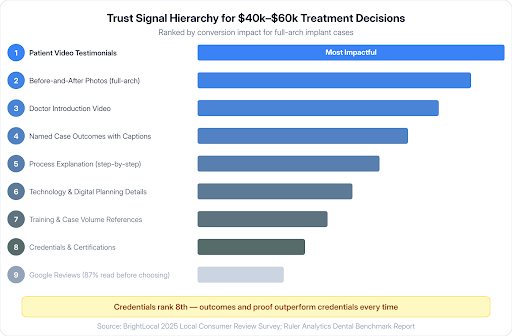
Trust signal hierarchy for full-arch cases, ranked by conversion impact:
Video testimonials from actual full-arch patients (named outcomes, specific stories)
Real before-and-after photos of full-arch cases (not single-tooth implants)
Doctor introduction video with philosophy and approach
Named case outcomes with brief patient story captions
Process explanation (step-by-step, from consult through delivery)
Technology and digital planning details (CBCT imaging, surgical guides, same-day protocols)
Training, case volume, and continuing education references
Credentials and certifications (in clinical context, not just listed)
Google reviews — 87% of patients read reviews before choosing a provider; 81% of new dental patients rely specifically on Google reviews (BrightLocal, 2025)
Notice that credentials rank eighth. They matter, but they matter less than proof of outcomes and less than the human signals of video and story. A page with fifteen credential badges and no video testimonials is less persuasive than a page with two credential badges and three real patient videos.
Where to Place Authority Signals on the Page
The most common mistake practices make is placing authority signals on the About page, where a full-arch prospect may never navigate. Authority signals must be placed at decision points — wherever the patient is evaluating whether to take the next step.
Placement rules:
- Top of the All-on-X landing page, immediately after the hero section
- Adjacent to every CTA (trust placed next to the ask reduces hesitation)
- Inside the FAQ section (reassurance at the exact point of doubt)
- On the homepage, within the Implant Center preview section
A review or patient photo placed directly above the consultation request form increases form completion. Trust placed next to the ask is always more effective than trust placed somewhere else on the page.
Do Before-and-After Photos Actually Increase All-on-X Conversions?
Real patient case photos are the most direct proof a full-arch prospect can see. Stock imagery signals that the practice does not have enough cases to show. Real photos signal that the practice performs this treatment regularly and achieves consistent outcomes.
If your before-and-after photos could belong to any practice, they are not working hard enough for yours.
Stock photos fail because they are interchangeable. Every dental website can license the same images from the same libraries. A prospect who has visited three practice websites before yours has already seen those smiling models. What they have not seen is your patients’ actual results. That distinction is the entire point.
Tells the patient that the practice has done this.
Tells the patient that this is one of the services they are highly specialized in.
The number of cases presented in the gallery greatly influences perceived value in the patient long before they even see you for the first time.
How to Build a Before-and-After Gallery That Converts
Format:
Full-arch before on the left, full-arch after on the right. Consistent composition, consistent lighting, consistent framing. Inconsistency in the gallery undermines confidence in the procedure — it looks accidental rather than systematic.
Caption structure:
Patient’s first name or initials, their primary problem before treatment, and their outcome. Example: “M.R. — Wore dentures for 12 years. Now eats whatever she wants and hasn’t thought about her teeth since.”
What to include:
Full-arch cases specifically, labeled clearly. Single-tooth implant photos in a full-arch gallery create confusion about what the practice actually specializes in.
What to avoid:
Watermarked stock photos, photos without context, photos without patient story captions, photos that show single-tooth results in a full-arch marketing context.
Always obtain written informed consent from patients before using their images. HIPAA compliance is not optional — it is the baseline for any patient photography program.
How Does Video Build Trust With Full-Arch Patients Before They Call?
Sixty-eight percent of all dental and cosmetic practice conversions happen via phone call, not by filling a form (Ruler Analytics). Video is what gets the patient to pick up the phone.
A patient who has watched a three-minute video of the doctor explaining the full-arch process; on what to expect, what it feels like, why the practice does it the way it does, arrives at the consultation already partially decided. Video compresses the trust-building timeline that would otherwise require multiple site visits, multiple reviews read, and multiple hesitations.
Pre-appointment educational video lifted implant consultation show rates from 28% to 41% in one documented case study. That is a 46% improvement in show rate from a single content asset.
75—85% show rate for full-arch consultations. Video is one of the most cost-effective tools available to reach that benchmark before the patient calls.
Priority video types for full-arch conversion:
Doctor introduction
Who the doctor is, why they chose implant dentistry, what they believe about full-arch treatment. This is the video that builds personal trust faster than any other asset on the site.
Patient testimonials
Real patients, real names, real stories. Not scripted. The patient describes the problem they had, the process they went through, and the outcome they received.
Process walkthrough
What happens from the initial consultation through surgery day through final arch delivery. The unknown is what keeps patients from calling. Naming the steps removes the unknown.
Office and technology tour
Familiarity before the first visit reduces anxiety. Seeing the operatory, the imaging equipment, and the team before arrival makes the first appointment feel less unfamiliar.
Where to Place Video on the Website
Homepage
Doctor introduction or a brief patient story — placed as the hero or directly below it. This is the highest-traffic page on the site. Video here has maximum exposure.
All-on-X landing page
Patient testimonial or process walkthrough — placed within the first scroll. By the time a prospect reaches your landing page, they are already interested. Video at this position converts interest into intent.
Before-and-after gallery
Pair video testimonials with corresponding photo cases. The combination of image and voice is more compelling than either alone.
Avoid
Placing all video content on a standalone “Patient Stories” or “Video Gallery” page that most visitors never navigate to. Video earns its value when it is placed in the path of the patient who is already evaluating.
The self-audit checklist in the section below includes a video checklist item. If you do not yet have a doctor introduction video, that is the first one you need to produce!
Guide Visitors From Curiosity to Consultation With a Better Conversion Path
Here is the structural problem with “Book Now” as the primary CTA for a full-arch website: it demands a commitment from a patient who is still in the Awareness or Trust stage of their decision arc. The patient who clicks “Book Now” on their first visit to your site is the exception, not the rule.
The average full-arch prospect visits 2—3 websites and reads 5 reviews before choosing a provider (Press Ganey, 2023). They are conducting due diligence on a $50,000 decision. A single “Book Now” button at the top of the page does not acknowledge the research process they are in the middle of.
Pushing the patient to commitment before trust is established loses the lead.
Offering a mid-funnel conversion step that captures intent without demanding commitment.
A downloadable All-on-X patient guide is the most effective mid-funnel offer for full-arch practices. It serves two purposes: it provides value to the patient (education, investment framing, process clarity, candidacy guidance), and it captures contact information from a patient who is actively researching.
What a strong implant guide includes:
- What full-arch implants are and who is a good candidate
- A plain-language process overview (consultation through delivery)
- Investment range and financing options explained honestly
- Why choosing the right provider matters more than choosing the lowest price
- A soft introduction to the practice, the doctor, and the approach
After a guide download, the practice team should follow up within 5 minutes. MIT and HubSpot research shows that contacting a lead within 5 minutes produces a 100x higher connection rate compared to following up 30 minutes later (MIT/HubSpot). A qualified patient who downloads a guide and receives a same-day call from a knowledgeable team member converts at dramatically higher rates than one who fills out a form and waits two days to hear back.
Speed-to-lead under 5 minutes on all form submissions and guide downloads.
CTA Language That Meets the Patient Where They Are
Awareness
“See Real Patient Results” / “Watch Full-Arch Stories”
“Book Now”
Trust
“Download the All-on-X Patient Guide” / “See If You Are a Candidate”
“Get a Free Quote”
Urgency
“Request Your Consultation” / “Schedule Your Evaluation”
“Call Us Today!”
“Get a Free Quote” commoditizes the case and attracts price-shoppers.
“Call Us Today!” creates urgency without a reason.
“See If You Are a Candidate” respects the patient’s research process and invites them into a conversation; on their terms, not yours.
Essential Conversion Optimization Elements for an All-on-X Website
The difference between a dental website converting at 2.3% and one converting at 23.1% is almost entirely explained by structural decisions and trust architecture — not traffic volume, not ad spend, not aesthetic design (Ruler Analytics). The following elements, properly implemented, move a website from the average toward the top of that range.
One clear action per page.
Every page should have a primary CTA. Not three. Not five. One. Competing CTAs create decision paralysis — the patient does nothing because they are not sure what they are supposed to do next.
Short forms with trust adjacent.
A form with ten fields loses patients. A form with three fields (name, phone number, best time to call) maintains completion rates. Place a patient review, a photo, or a short testimonial snippet directly above or beside the form. Trust placed next to the ask is always more effective than trust placed elsewhere on the page.
Financing language on the landing page.
The investment question is on every full-arch patient’s mind before they contact the practice. Addressing it proactively on the page — “Most patients finance their full-arch restoration. Flexible monthly payment options are available.” — reduces the barrier to inquiry. Patients who know financing is possible are more likely to call. Patients who have to ask are more likely to leave.
Mobile optimization.
All-on-X patients skew 45—65 years old. Test the site on a real mobile device. The phone number must be one tap to call. Forms must be completable without pinch-zoom. Pages must load in under three seconds. For this demographic, a desktop-optimized website that functions poorly on mobile is losing inquiries every day.
All-on-X Website Conversion Self-Audit (10 Points)
Run through this checklist against your current website. Each unchecked item is a conversion opportunity you are not capturing.
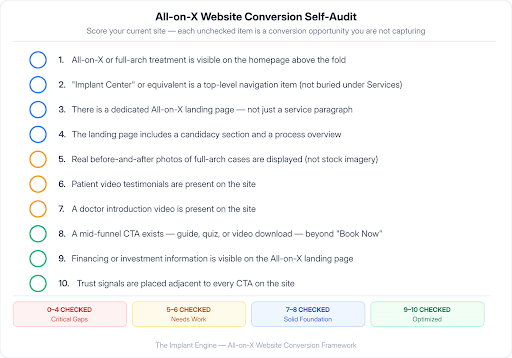
If you checked fewer than 7 of these boxes, your website is structurally underperforming for full-arch conversion — regardless of how much traffic your ads are sending to it.
Structure Your Site So Google and Users Both Understand Your Implant Focus
Site architecture is simultaneously a user experience decision and a search engine optimization decision. Google’s topical authority model rewards websites that cover a subject completely and coherently over websites that mention it briefly. A general practice website with one implant page tells Google that implants are a minor topic. A practice website with an Implant Center hub and six supporting pages tells Google — and every patient who visits — that implants are a core competency.
Every All-on-X page on your site internally links to at least three other implant-specific pages.
The hub-and-spoke model for implant content organizes all related pages under a central Implant Center hub. Every spoke page links back to the hub. The hub links to every spoke. Spoke pages cross-link to related spokes where contextually relevant.
The Implant Center Hub Structure
The Implant Center overview. Links to all spoke pages. Introduces the doctor, the practice’s approach to full-arch treatment, and the range of services available.
Spoke pages:
All-on-X / All-on-4 Service Page
The primary landing page for full-arch implant candidates. Candidacy, process, proof, and CTA.
Full-Arch Dental Implant Cost Page
Investment range, monthly payment options, what is included, how to evaluate cost versus value.
Before-and-After Gallery Page
Full-arch case photos organized by case type. Patient story captions on every case.
Patient Testimonial Video Page
Video testimonials, each labeled with patient name (or initials), their presenting problem, and their outcome.
Candidacy and FAQ Page
Who is a candidate, who is not, common questions from the consideration-phase patient.
Technology and Digital Planning Page
CBCT imaging, digital surgical guides, same-day protocols, sedation options.
Consultation Request Page
What to expect from the consultation, what to bring, how long it takes, and a simple three-field form.
This structure creates multiple entry points for patients at different stages of research. The cost-page patient is in early awareness. The consultation-request patient is ready to act. Both need to find what they are looking for without hunting.
A practice with seven interlinked implant-specific pages has established topical depth that a practice with one implant paragraph cannot match. Google rewards topical completeness, and patients reward navigational clarity.
Common Website Mistakes That Cost General Practices All-on-X Cases
Most general practices do not lose full-arch cases because their website is poorly designed. They lose them because the website fails at three things: communicating trust, guiding the patient to the next step, and making the practice feel like the right choice for this specific treatment.
Symptom → Cause → Fix
High bounce rate on All-on-X page
Page too thin; patient intent not matched
Expand to full landing page with candidacy, process, proof
Low form completions
Form too long; no trust signals adjacent
Shorten to 3 fields; add a patient review next to the form
Leads arriving but not converting on call
Site pre-frames price without establishing authority
Add doctor video, patient testimonials, and process clarity before any CTA
Implant page ranks in Google but does not generate calls
Copy is clinical; not outcome-oriented
Rewrite with patient transformation language; add social proof throughout
No implant-specific inquiries despite site traffic
Implants buried in general services menu
Add Implant Center to top-level navigation; create a dedicated hub
Additional common mistakes:
- Using stock photos when real patient cases are available
- No process explanation anywhere on the site (the unknown keeps patients from calling)
- Financing information absent from the landing page
- No video content of any kind
- No mid-funnel CTA — “Book Now” is the only option at every stage
- Doctor credentials listed but never placed in the context of full-arch expertise
- Mobile experience tested only on a desktop browser in mobile view, not on an actual phone
Each of these mistakes has a direct, measurable cost: a patient who arrived qualified and left unconverted.
Your Website Must Sell Confidence, Not Just Services
An All-on-X patient is not choosing a procedure. They are choosing a doctor, a practice, and a life change. They have been researching for months. They have fears they may not have named out loud. They are hoping the next website they visit will finally give them a reason to stop looking and start calling.
The website that wins that patient is not the most elaborate one. It is the most trustworthy one.
Trust and specialization drive full-arch conversions more than design, more than ad spend, and more than traffic volume. The compounding effect of a properly positioned website is significant: better positioning attracts better-qualified leads, better-qualified leads accept cases at higher rates, and higher case acceptance multiplies the return on every marketing dollar spent.
Case acceptance of 35% or more on qualified full-arch consultations; the benchmark cited by Henry Schein for high-performing implant practices, begins before the patient walks through the door. It begins with what the patient believes about your practice from what they read, watched, and evaluated on your website. The website creates the conditions for acceptance. The consultation closes it.
If your website currently positions your practice as convenient and comprehensive rather than specialized and trustworthy, that is what needs to change before the next ad dollar is spent.
The next step is a website audit — an honest assessment of each element in this article against your current site. If you want to assess where your website stands and identify the highest-leverage changes available, request a free website strategy consultation here or book a strategy call with The Implant Engine team.
Frequently Asked Questions
A general dental practice increases All-on-X case volume from its website by restructuring around three priorities: dedicated infrastructure, proof assets, and a guided conversion path. This means adding "Implant Center" to the top-level navigation, building a dedicated All-on-X landing page with candidacy information and process overview, publishing real before-and-after photos and patient testimonials, and replacing a single "Book Now" CTA with a staged sequence that moves patients from awareness through education to consultation request. The dental industry's average website conversion rate is 2.3%, but top-performing practices reach 23.1% (Ruler Analytics). That gap is structural, not a traffic problem.
A high-converting All-on-4 dental implants website should include nine core elements: (1) an outcome-oriented hero section above the fold, (2) a candidacy section explaining who qualifies, (3) a plain-language process overview from consult through delivery, (4) a doctor authority block with credentials in context, (5) a real before-and-after photo gallery of full-arch cases specifically, (6) patient video testimonials with named outcomes, (7) investment and financing information, (8) a FAQ section targeting consideration-stage questions, and (9) a low-friction CTA such as "See If You Are a Candidate" rather than "Book Now." Pages shorter than 800 words will not match the research depth full-arch patients require.
A generic services page fails to convert implant patients because it is built for a different decision type. Routine dental patients need quick access to scheduling. Full-arch patients need evidence of specialization, clinical authority, process clarity, and proven outcomes — none of which a short services paragraph can provide. Patients visit an average of 2–3 sites and read 5 reviews before choosing a healthcare provider (Press Ganey, 2023). For a $50,000 decision, a two-paragraph service blurb signals that the practice treats full-arch as an incidental offering rather than a clinical specialty.
The most effective primary CTA for a dental implant landing page is "See If You Are a Candidate" or "Request Your Implant Consultation." These outperform "Book Now" because they meet the patient in evaluation mode — uncertain, researching, and not yet ready to commit to an appointment. "Book Now" demands a commitment most full-arch patients are not ready to make on a first visit. "See If You Are a Candidate" reduces friction at the critical decision point and attracts patients who are genuinely interested in the procedure rather than patients who book and cancel. Secondary CTAs should include a mid-funnel offer such as a downloadable All-on-X patient guide.
Yes. Real patient before-and-after photos are among the most effective trust signals available for full-arch conversion. They provide direct visual proof of outcomes, signal that the practice performs this treatment regularly, and reduce the uncertainty that keeps patients from calling. Stock imagery produces the opposite effect — it signals that the practice does not have enough real cases to show and makes the site interchangeable with every other practice using the same photo library. A gallery of 10 or more full-arch cases signals specialization; 20 or more signals high volume. Every photo should include a patient caption connecting the image to a real human story, with proper HIPAA-compliant consent in place.
Video is important because it compresses the trust-building process that would otherwise require multiple site visits, multiple reviews read, and multiple hesitations. A patient who watches a doctor introduction video and a patient testimonial video arrives at the consultation already partially decided. Pre-appointment educational video has been shown to lift implant consultation show rates from 28% to 41% (Progressive Dental Marketing) — a 46% improvement in show rate from a single content investment. Since 68% of all dental practice conversions happen via phone call (Ruler Analytics), video is what builds sufficient trust to get the patient to pick up the phone.
Yes. A dedicated Implant Center hub page serves two functions simultaneously: it creates a clear navigational pathway for full-arch prospects, and it signals topical depth to search engines. Google's topical authority model rewards websites that cover a subject completely. A practice with a hub page linking to six or seven supporting implant-specific pages (service page, cost page, gallery, testimonials, FAQ, consultation request) establishes the kind of topical depth that a practice with a single service paragraph cannot match. The Implant Center hub also separates the full-arch patient journey from the routine patient journey, allowing each pathway to be optimized independently.
A full-arch dental implant landing page should cover nine sections: an outcome-oriented hero with CTA, a candidacy explanation (who qualifies for full-arch treatment), a step-by-step process overview from consultation through arch delivery, a doctor authority section with credentials placed in clinical context, a before-and-after photo gallery of full-arch cases only, patient video testimonials, a financing and investment section with monthly payment framing, a FAQ block targeting the consideration-stage patient, and a final CTA with trust signals adjacent. Pages that omit candidacy or process information leave the patient's most important questions unanswered and reduce the likelihood they will call. Every section should be designed around reducing the unknown — because the unknown is what keeps full-arch patients from converting.
A general practice website signals implant specialization through four structural changes: (1) add "Implant Center" or "Full-Arch Implants" to the top-level navigation — not buried under Services; (2) feature full-arch outcomes above the fold on the homepage with outcome-oriented headline copy; (3) replace stock imagery with real before-and-after photos of full-arch cases from the practice; and (4) build a hub-and-spoke site architecture around the Implant Center, with a dedicated All-on-X landing page, cost page, gallery page, and testimonial page all interlinked. These changes do not require redesigning the entire site. They require repositioning the parts of the site that full-arch patients see first and judge hardest.
Conclusion
The full-arch patient your ads are reaching right now is going to visit your website before they call. What they find there will determine whether they call you or the practice down the street.
Your website is the first impression for a patient who has been researching for months, reading reviews, watching videos, and building a mental picture of what the right practice looks like. If that impression does not communicate specialization, authority, proven outcomes, and a guided pathway from curiosity to consultation — they will keep looking.
The changes described in this article do not require a complete redesign. They require a repositioning: moving full-arch implants from buried services entry to featured center of gravity, building the trust infrastructure that high-ticket patients require before they commit, and creating a conversion path that meets patients where they actually are rather than where it is convenient to assume they are.
If you want a direct assessment of your current website’s full-arch conversion potential, request a free strategy call with The Implant Engine. We will review your current site against the framework in this article and identify the highest-leverage changes available to you.